Forest School
Patterdale Forest School Curriculum
INTENT
All our children experience a weekly Forest School and Outdoor session led by an experienced teacher and qualified Forest School Practitioner.
Our aim is for the children to leave Patterdale confident and equipped to take on the world. During the sessions the children spend time learning about and in our beautiful surroundings.
We foster child led learning, develop practical skills, build resilience and support children to identify and manage risks independently to keep themselves and others safe.
Alongside the teaching of practical skills children get the opportunity to learn about our natural world, rural life and sustainable food production.
Most importantly our children get the opportunity to be children - get dirty, be curious, have adventures and play!
TEACHING MIXED AGE CLASSES
Children are taught in mixed age classes.
Principles of Forest School
Forest School is an educational approach rooted in the Scandinavian educational system, focusing on outdoor learning and the development of a strong relationship between children and nature. It promotes self esteem, creativity, confidence, and independence through a structured yet flexible learning environment. The pedagogy is characterised by six core principles that guide its implementation and practice.
Forest School is defined by 6 core principles, which were agreed by the Forest School community in 2011. These pre-date the FSA, which was set up in 2012 to support and advocate for these principles. The principles are underpinned by criteria. The FSA has used these as a basis for a set of national professional standards that we can all aspire to.
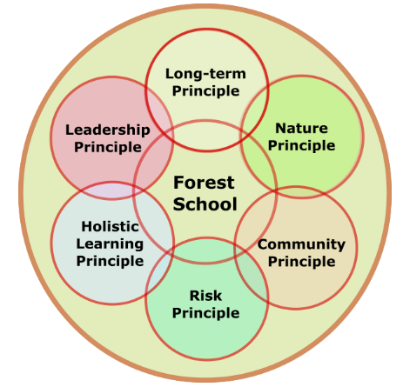
The Long-Term Principle
Forest School is a long-term process of frequent and regular sessions in a woodland or natural environment, rather than a one-off visit. Planning, adaptation, observations and reviewing are integral elements of Forest School.
The Nature Principle
Forest School takes place in a woodland or natural wooded environment to support the development of a relationship between the learner and the natural world
The Risk Principle
Forest School offers learners the opportunity to take supported risks appropriate to the environment and to themselves.
The Holistic Learning Principle
Forest School aims to promote the holistic development of all those involved, fostering resilient, confident, independent and creative learners.
The Leadership Principle
Forest School is run by qualified Practitioners who continuously maintain and develop their professional Practice.
The Community Principle
Forest School uses a range of learner-centred processes to create a community for development and learning.
CONTENT
Forest School, Outdoor Learning and Environmental Curriculum
Our Forest School, Outdoor Learning and Environmental Study curriculum is organised into the following eight areas. These areas aren’t exclusively taught as individual areas but are used as a way of organising our thoughts, knowledge and ideas as we progress through the school.
Animals
We will learn about our native and non-native fauna and how they fit into our ecosystem.
Plants and Trees
We will learn to identify our native and non-native species of plants and tree.
Seasonal Change
We will watch and observe the seasons and the impact on our local area.
Gardening, Cooking and Food Preservation
We will learn about different gardening methods, food that grows well in our climate and how to grow and develop a seasonal garden producing food for our school kitchen. We will learn how to prepare and cook with the food we grow.
Spiritualism, Reflection and Connecting with Nature
Engaging with nature can foster a sense of awareness, mindfulness and healing while also serving as a catalyst for creativity and introspection.
Forest School Skills
Forest school skills will be taught using the wild passport as a guide. These skills will be taught both discreetly and taught through other areas of the outdoor curriculum. Progress will be marked against the Wild Passport.
Sustainability, Climate and Environmental Impact
We will look at how sustainable practices can mitigate the impact on the environment and the climate.
Rural Life
We will learn about what life is like in a rural community and how it has changed over time. We will explore jobs and employment opportunities within the rural sector.
ASSESSMENT & MONITORING
We use the Wild Passport to ensure and track skill progression throughout the children’s time at Patterdale.


