Maths
Patterdale Maths Curriculum
INTENT
We recognise that mathematics is a fundamental skill which underpins so many aspects of everyday life. Our mathematics curriculum is aimed to equip children to become fluent in number, confident in their mathematical reasoning and able to solve problems with resilience. Our aim is to make mathematics engaging and enjoyable and to prepare children for secondary school and beyond.
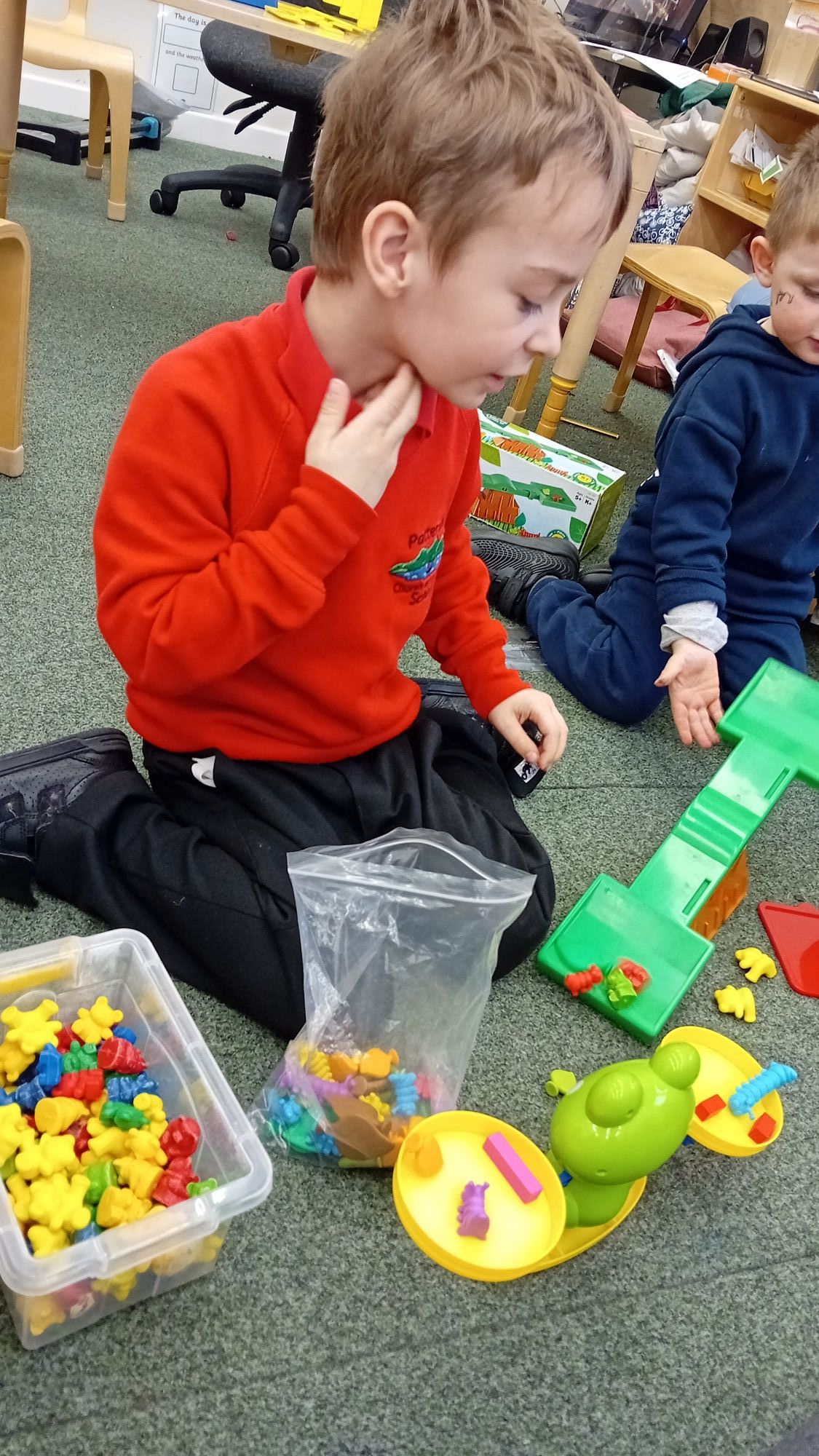
From the Early Years, we begin to develop basic number skills by using manipulatives and patterns to build solid foundations in the concept of number.
Throughout Key Stage 1 and 2, we build upon these foundations to develop children’s fluency in number to equip them with a range of strategies to solve increasingly complex problems confidently. We create an environment in which it is safe to make mistakes using a range of teaching methods. Mathematics across the school is taught using pictorial and concrete resources before moving onto abstract representations, and children are given the chance to develop knowledge through being taught in small, sequential steps.
TEACHING MIXED AGE CLASSES
Children are taught in mixed-aged classes which include:
- Clear progression
- Clear objectives that are well thought through from the White Rose curriculum.
- Manipulatives are used to support and embed learning where appropriate.
- Support given to children to enable them to succeed
- Appropriate challenge within the year group expectations
- Opportunity to develop fluency skills
- Opportunity to develop reasoning skills
- Opportunity to develop problem-solving skills
CONTENT
At Patterdale C of E Primary School we use White Rose maths. It uses a mastery approach to maths teaching. It is a research-driven teaching and learning method that meets the goals of the National Curriculum and is closely aligned to the DFE’s ready to progress criteria.
What does it mean in practice? In summary, a mastery approach…
- Puts numbers first: The schemes have number at their heart, confidence with numbers is the first step to competency in the curriculum as a whole.
- Puts depth before breadth: it reinforces knowledge again and again.
- Encourages collaboration: children can progress through the schemes as a group, supporting each other as they learn.
- Focusses on fluency, reasoning and problem-solving: it gives children the skills they need to become competent mathematicians.
At the heart of the mastery approach is the Concrete Pictorial Abstract (CPA) approach. Research shows that when children are introduced to a new concept, working with concrete physical resources and pictorial representations leads to a better understanding of abstract concepts. White Rose uses CPA throughout its schemes of learning.
White Rose maths resources help pupils with problem-solving and number fluency, by nurturing confidence in mathematical thinking. We don’t think any child should be intimidated by numbers. In fact, we think they should be excited by what numbers can help them do.
ASSESSMENT & MONITORING
Formative assessment takes place at the end of each session.
Ongoing practical assessments carried out in Early Years.
Year 1 – Year 6 End of unit assessments are carried out to assess understanding.
Year 1 - Year 6 End of term Test Base assessments for arithmetic and reasoning are carried out.