INTENT
At Patterdale we provide children with opportunities to study a range of texts which will support their writing. We recognise the importance of the link between reading and writing and explore this with children.
By the time children leave Patterdale, we would like them to have a love for writing and to have a clear understanding of different types of writing for different purposes and audiences. We equip them with the tools to use a range of skills in their writing and consider carefully the effect on the audience they are writing for. We also provide opportunities for planning and drafting as well as editing and polishing work. On occasions, this is done with peers, so children learn from each other and from each other’s mistakes.
We immerse our children in a language-rich, creative English curriculum which develops a love of reading, creative writing and purposeful speaking and listening. We provide children with opportunities to learn and study texts from a diverse range of authors throughout our whole school curriculum. Reading across the curriculum is a way in which we help children to build on their fluency and their comprehension, which also supports their writing. We recognise the importance of the link between reading and writing and explore this with children.
At Patterdale, we feel it is our duty to unlock the door to a lifelong love of literature and to provide children with the tools to develop a critical eye and an ability to write, and express themselves, independently, across a range of genres and for a range of purposes. At Patterdale, we celebrate mistakes. Children are encouraged to scan their writing for errors and are taught to edit, which becomes part of their daily practice. We understand that letting children learn from their mistakes helps build resilience and is essential in raising confident, capable, happy, and successful people as well as writers.
TEACHING MIXED AGE CLASSES
Children are taught in mixed age classes. Our writing curriculum is planned on a 4-year cycle, to meet the requirements of the national curriculum.
CONTENT
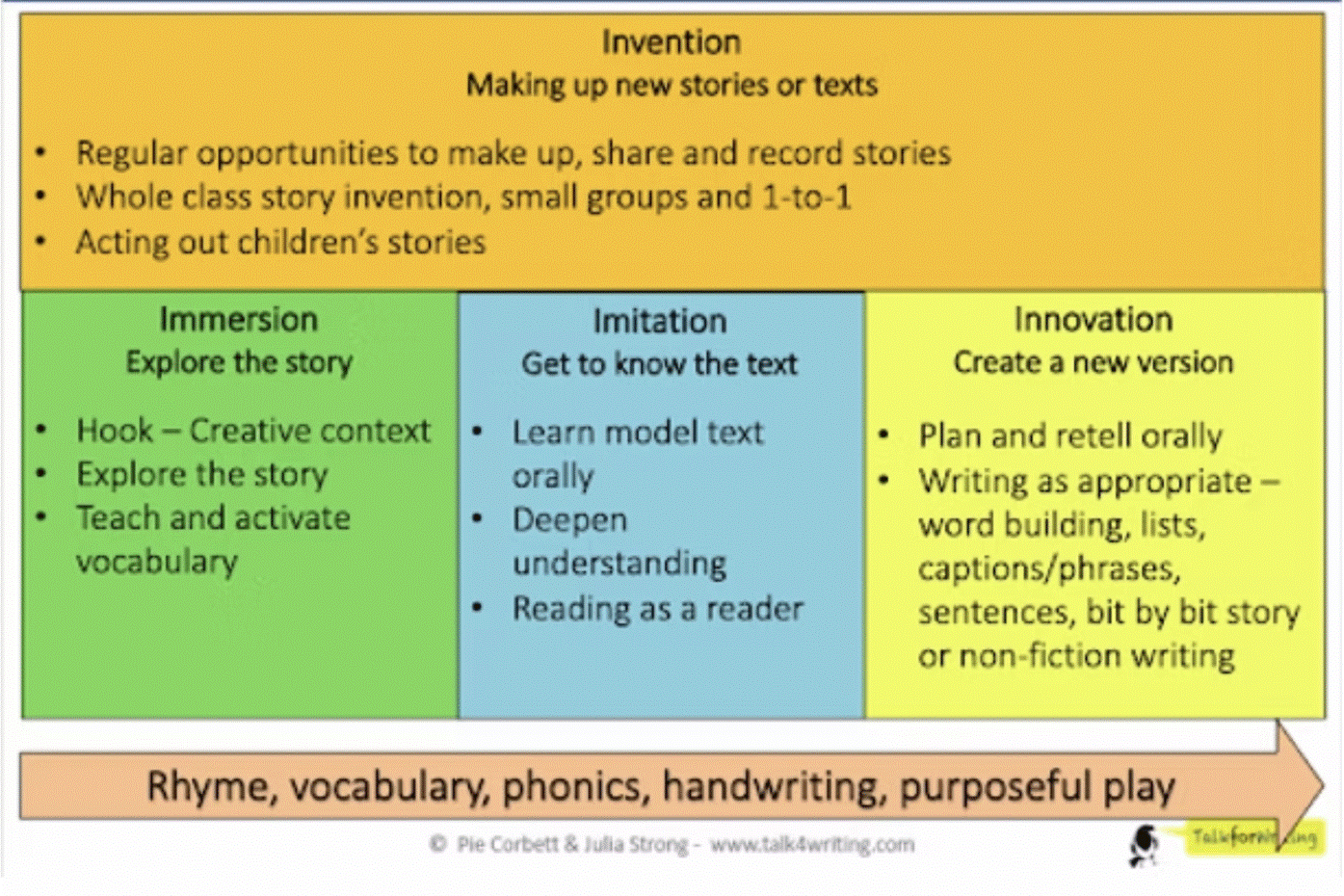
Here at Patterdale we teach writing through the Talk for Writing approach, which enables children to read and write independently for different audiences and purposes. At the beginning of each unit, all pupils learn a new story map, which they can recite with actions and expression. Through ‘talking the text’, children internalise different language structures, patterns and vocabulary needed to write. The approach moves from dependence towards independence, with our teachers using shared and guided teaching to develop our pupils’ ability to write creatively and powerfully.
Click on the video below to watch Talk for Writing founder and Literacy expert, Pie Corbett, give a brief overview of the Talk for Writing approach and why it works.
Keldas Teaching Sequence

Helvellyn Teaching Sequence
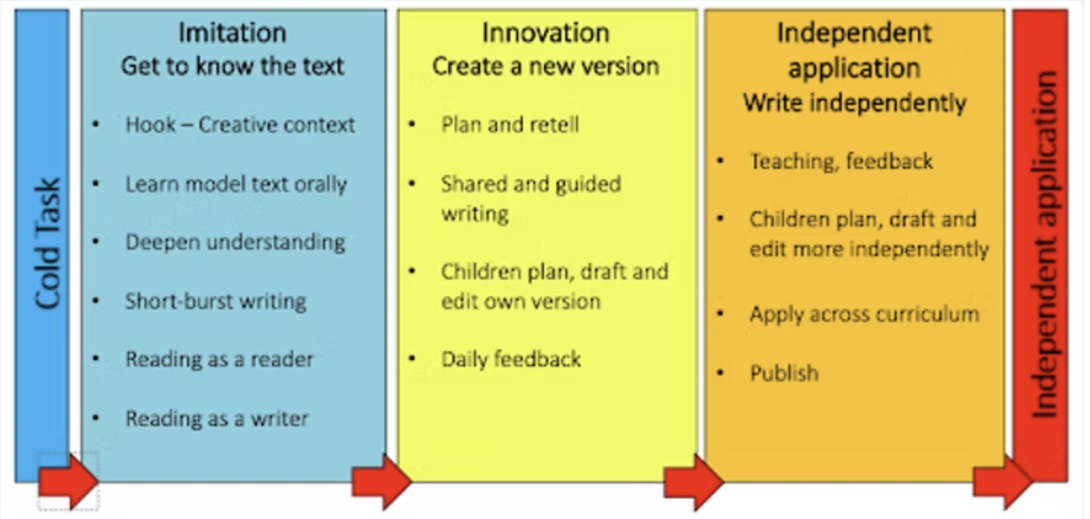
The key stages of the Talk for Writing process enable children to imitate orally the language they need for a particular topic, before reading and analysing it, and then writing their own version.
In addition, lessons contain a SPaG activity based on summative and formative assessment— introducing, reviewing or practising a key skill in an engaging, memorable way.
Lots of short burst writing activities are provided throughout the unit.

Spelling is taught through the Spelling Shed program. Spelling Shed's approach to spelling involves the relationship between sounds and written symbols as well as using morphology to help spell through meaning. The carefully selected word lists and engaging activities provide opportunities to incorporate phonics and meaning to strengthen spelling skills and build vocabulary acquisition.

Handwriting is based on Letter Join. Letter-join’s handwriting scheme provides a structured teaching programme which supports the DfE’s 2025 Writing Framework and new UK curriculum review. The Writing Framework (July 2025) emphasises the importance of progressive development and handwriting as a key transcription skill for fluent and legible writing.
ASSESSMENT & MONITORING
EYFS: half termly phonic assessments
Year 1: half termly phonic assessments and end of year Phonics Screening.
Year 2 - Year 6: A cold task at the beginning of each unit, then the final piece will be moderated by the staff against the National Curriculum requirements at the end of each term.
Year 2 – Year 6: Test Base SPAG Test at the end of each term. A spelling assessment for each term on Spelling Shed.
Staff will attend cluster sessions on writing.
INTENT
At Patterdale, we recognise that being able to read is a vital life skill and has far-reaching implications for lifelong goals, confidence and wellbeing. We promote a love of reading in all classrooms and want to ignite a passion for reading in all children as soon as they start school.
High quality, consistent phonics teaching and access to phonetically decodable books provides all children with the chance to develop the starting point they need as they begin their journey in education. Across the school, we teach a range of reading skills which will allow children to comprehend a variety of texts.
The range of authors and text types we look at provide children with a balanced reading diet and encourage children to explore different authors and genres. Opportunities to share reading with others are built in to the school day and sharing books and texts provides children with opportunities to learn from each other and learn from mistakes. We also have reading volunteers who come into school.
TEACHING MIXED AGE CLASSES
Children are taught in mixed age classes and follow a 3/4-year plan for their reading. High quality reading texts are chosen for the children and these match the text types being used for their writing.
CONTENT
At Patterdale, we teach reading daily. We expose children to a number of different fiction and non-fiction texts and provide opportunities for the children to discuss what they have read whilst making links, asking questions and making predictions.
We believe that while providing children with a love and appreciation of reading, it is also our responsibility and duty to ensure all children leave us with the fundamental skills to enable them become lifelong readers.
Each daily lesson contains an opportunity to practise fluency, oracy, and we recap previously introduced vocabulary.
We use VIPERS, which enable us to ask appropriate questions linked to the knowledge and skills children need to improve their comprehension of texts. (We use the Literacy Shed VIPERS).

Reading is an important skill for life and we aim to produce children who are confident readers and who enjoy reading.
The children at Patterdale will:
At Foundation Stage, we will encourage and support children in the development of pre-reading skills as part of the process of becoming fluent readers.
At Key Stage 1/2 teachers/adults in school will hear each child read regularly and children will take books home for parents to share and support their reading development.
Stories and poetry are read to children at all stages within the school to stimulate their reading for pleasure. The school has a library with a wide range of books which the children can access independently.
ASSESSMENT & MONITORING
EYFS: half termly phonic assessments
Year 1: half termly phonic assessments and end of year phonics screening.
Year 2 - Year 6: Using FFT reading assessment tests (Fluency and Decoding), the children will carry out a September baseline and end of term assessments.
Year 2 – Year 6: Test Base Reading Comprehension Test at the end of each term.
INTENT
At Patterdale, we recognise that being able to read is the most important skill children will learn during their early schooling and has far-reaching implications for lifelong goals, confidence and well-being. The combination of phonics teaching, effective interventions and access to phonetically decodable books provides all children with the chance to develop the starting point they need as they begin their journey in education. We seek to develop a love for reading and provide our children with a wealth of reading material, introducing them to various authors and different types of genres.
TEACHING MIXED AGE CLASSES
Children are taught in mixed age classes and follow the Little Wandle Phonics Program.

CONTENT
We use the ‘Little Wandle Letters and Sounds’ Teaching Program to systematically teach phonics. This is a fully comprehensive programme where children start learning single letter sounds in the Autumn Term of Reception, progressing to the more complex code in Year 1. This progression prepares children for the statutory phonics screening check that takes place at the end of Year 1.
Phonics is taught every day and children learn to apply their phonics knowledge in reading practice sessions throughout the week. Each reading session focusses on a different skill, developing children’s prosody, fluency and comprehension skills along the way.
Please download the progression of phonemes taught by clicking this link here:
ASSESSMENT & MONITORING
INTENT
At Patterdale C of E Primary School we believe that speaking and listening are fundamental to the teaching of English and that it permeates the whole curriculum – cognitively, socially and linguistically. We want our children to develop effective communication skills for the here and now and in readiness for later life. By building a culture of oracy within our school, we want to develop our children’s confidence, spoken language and written outcomes across and beyond the curriculum. Our aim is to enable children to improve their levels of oracy so that they express themselves clearly and can communicate effectively and confidently in front of any type of audience. These skills are being encouraged in every area of our curriculum as good oracy skills can enhance every type of learning, including maths and science. A key part of oracy is for children to think carefully about the language they’re using, and tailor it to their subject, purpose and audience. So much in life depends on being a good communicator, so it’s vital that children learn the importance of oracy from a young age. Children who start school with limited communication skills are six times less likely than their peers to reach the expected standards in English at the end of Year 6. We are aware of children’s different starting points. Therefore, developing oracy skills is crucial in improving our children’s life opportunities. We also recognise that children who communicate well are more likely to form good relationships with other children and adults. Therefore, it is important that our children can listen to others and respond appropriately.
TEACHING MIXED AGE CLASSES
Children are taught in mixed age classes. Oracy will be taught throughout the curriculum using the progression of skills document to focus specific skills at the appropriate age and stage.
CONTENT
The oracy framework breaks down the teaching of speaking and listening into four strands: Physical, Cognitive, Linguistic and Social and Emotional. We promote classrooms rich in talk, in which questions are planned, peer conversations are modelled and scaffolded and the teacher uses talk skilfully to develop thinking. From EYFS to Year 6, children are given opportunities to develop oracy skills and build their confidence in talk for formal and informal situations, both in and outside the classroom.
We ensure the children have an opportunity to practice a variety of types of talk and practice the skills needed for different oracy outcomes:
· exploratory talk
· interactive/negotiation
· recitation
· debate and persuasion
· building understanding
· to inform/teach
· entertainment and expression

The teaching of oracy across the school and throughout the curriculum will support our children to make progress in the four strands of oracy.
A range of purposeful opportunities are used to encourage learning through talk and learning to talk, including:
· Setting ground rules for speaking and listening in class, such as putting your hand up before speaking, waiting to be chosen, and not interrupting each other.
· Discussions such as in a pair, small group or whole class, for example about religious beliefs, story plots, or predicting the outcomes of experiments.
· Hot seating: a drama technique where one child sits in the ‘hot seat,’ and the other children ask them questions to answer in character.
· Exploring a text through performance – not just re-enacting what happens in the book, but also acting out what characters might do or say in a particular situation.
· Debates, with one group of pupils for and another against a certain topic or question, such as, ‘Is it right to bully a bully?’
· Putting on Collective Worship e.g. Harvest, attended by the rest of the school and often parents.
· Group work, where communication and listening to each other are essential.
· Role play, where children pretend to be someone else or pretend to be in a specific situation that they are not actually in at the time.
Through the teaching of oracy, children will be able to:
· Speak fluently, with confidence and clarity in front of an audience, including talking in full sentences
· Explore ideas through talk
· Deliberately select gestures that support the delivery of ideas, e.g. gesturing towards someone if referencing their idea
· Recognise the value of listening to what others say
· Use conjunctions to organise and sequence their ideas
· Adapt how they speak in different situations according to the audience, including using Standard English
· Value their own opinions and be able to express them to others
· Begin to reflect on their oracy skills and identify areas of strength and areas to improve
· Ask questions to find out more about a subject
· Respond appropriately to what others say, challenge each other’s opinions and develop their own reasoned arguments
· Be open-minded, value the contribution of others and take account of their views
· Appreciate the diversity of languages, dialects and accents in the school
· Consider the impact of their words on others when giving feedback
· Share their learning in an engaging, informative way through formal presentations