Writing
Patterdale Writing Curriculum
INTENT
At Patterdale we provide children with opportunities to study a range of texts which will support their writing. We recognise the importance of the link between reading and writing and explore this with children.
By the time children leave Patterdale, we would like them to have a love for writing and to have a clear understanding of different types of writing for different purposes and audiences. We equip them with the tools to use a range of skills in their writing and consider carefully the effect on the audience they are writing for. We also provide opportunities for planning and drafting as well as editing and polishing work. On occasions, this is done with peers, so children learn from each other and from each other’s mistakes.
We immerse our children in a language-rich, creative English curriculum which develops a love of reading, creative writing and purposeful speaking and listening. We provide children with opportunities to learn and study texts from a diverse range of authors throughout our whole school curriculum. Reading across the curriculum is a way in which we help children to build on their fluency and their comprehension, which also supports their writing. We recognise the importance of the link between reading and writing and explore this with children.
At Patterdale, we feel it is our duty to unlock the door to a lifelong love of literature and to provide children with the tools to develop a critical eye and an ability to write, and express themselves, independently, across a range of genres and for a range of purposes. At Patterdale, we celebrate mistakes. Children are encouraged to scan their writing for errors and are taught to edit, which becomes part of their daily practice. We understand that letting children learn from their mistakes helps build resilience and is essential in raising confident, capable, happy, and successful people as well as writers.
TEACHING MIXED AGE CLASSES
Children are taught in mixed age classes. Our writing curriculum is planned on a 4-year cycle, to meet the requirements of the national curriculum.
CONTENT
Here at Patterdale we teach writing through the Talk for Writing approach, which enables children to read and write independently for different audiences and purposes. At the beginning of each unit, all pupils learn a new story map, which they can recite with actions and expression. Through ‘talking the text’, children internalise different language structures, patterns and vocabulary needed to write. The approach moves from dependence towards independence, with our teachers using shared and guided teaching to develop our pupils’ ability to write creatively and powerfully.
Click on the video below to watch Talk for Writing founder and Literacy expert, Pie Corbett, give a brief overview of the Talk for Writing approach and why it works.
Talk For Writing Across the school
Keldas Teaching Sequence
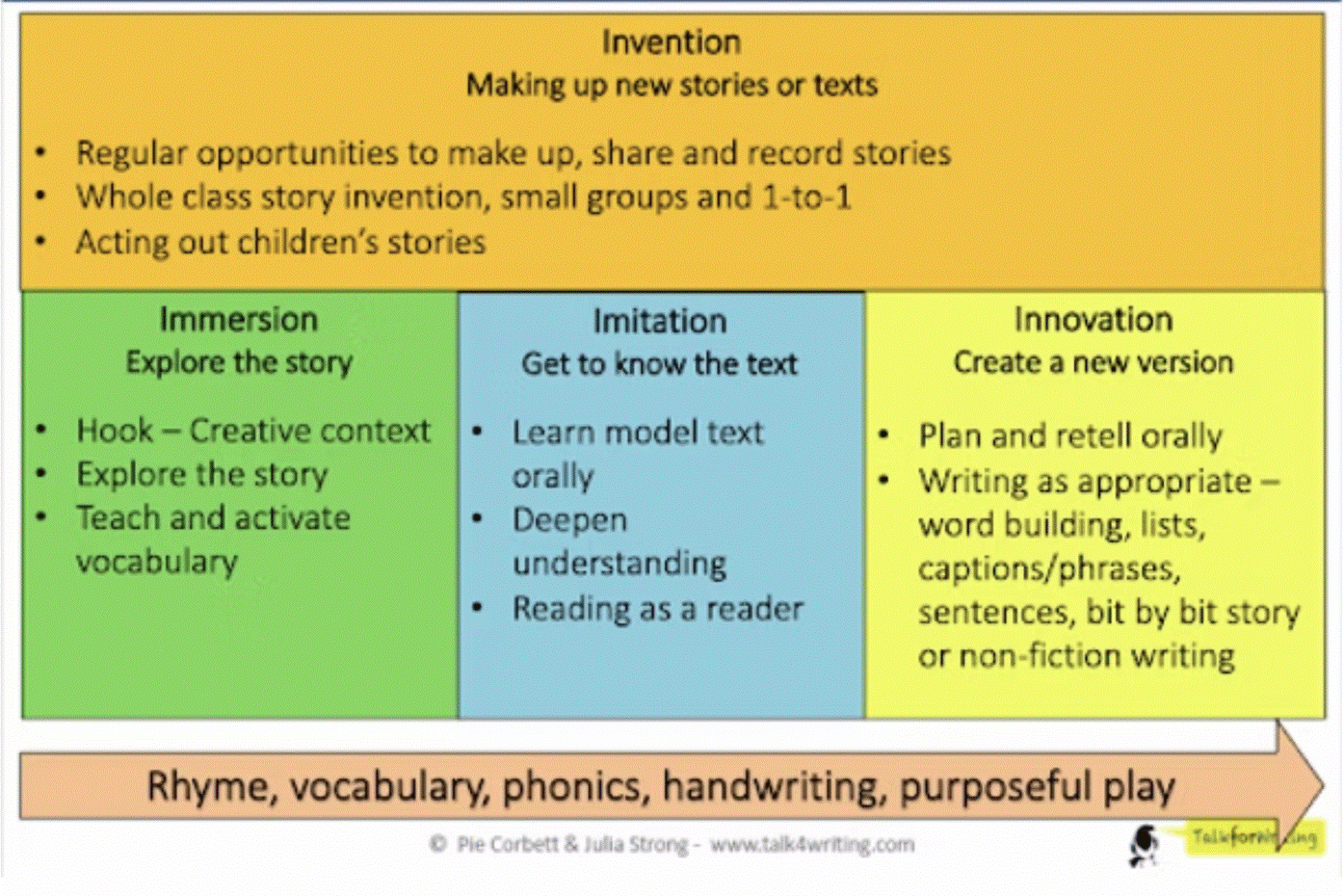
Helvellyn Teaching Sequence
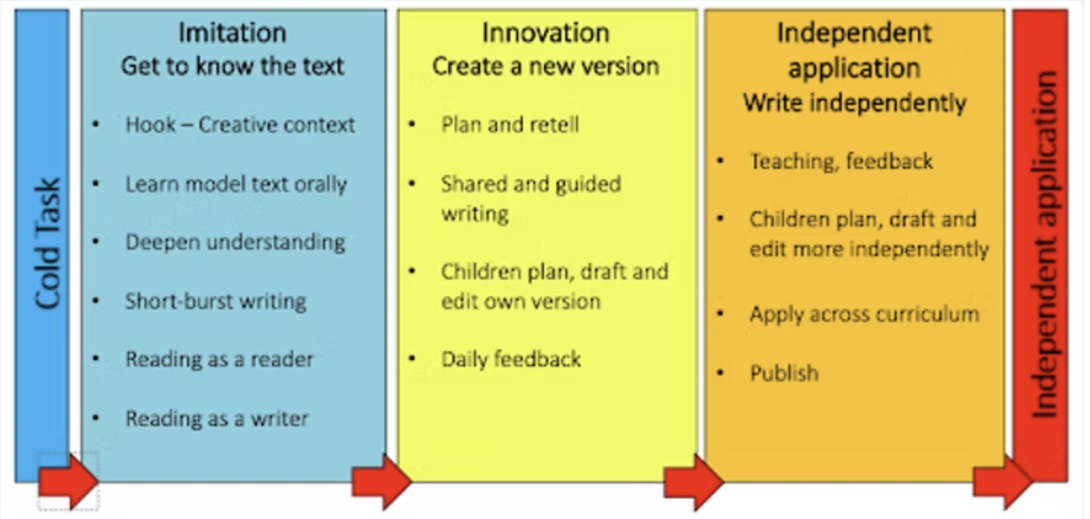
The key stages of the Talk for Writing process enable children to imitate orally the language they need for a particular topic, before reading and analysing it, and then writing their own version.
In addition, lessons contain a SPaG activity based on summative and formative assessment— introducing, reviewing or practising a key skill in an engaging, memorable way.
Lots of short burst writing activities are provided throughout the unit.
 Spelling is taught through the Spelling Shed program. Spelling Shed's approach to spelling involves the relationship between sounds and written symbols as well as using morphology to help spell through meaning. The carefully selected word lists and engaging activities provide opportunities to incorporate phonics and meaning to strengthen spelling skills and build vocabulary acquisition.
 Handwriting is based on Letter Join. Letter-join’s handwriting scheme provides a structured teaching programme which supports the DfE’s 2025 Writing Framework and new UK curriculum review. The Writing Framework (July 2025) emphasises the importance of progressive development and handwriting as a key transcription skill for fluent and legible writing.
ASSESSMENT & MONITORING
EYFS: half termly phonic assessments
Year 1: half termly phonic assessments and end of year Phonics Screening.
Year 2 - Year 6: A cold task at the beginning of each unit, then the final piece will be moderated by the staff against the National Curriculum requirements at the end of each term.
Year 2 – Year 6: Test Base SPAG Test at the end of each term. A spelling assessment for each term on Spelling Shed.
Staff will attend cluster sessions on writing moderation.